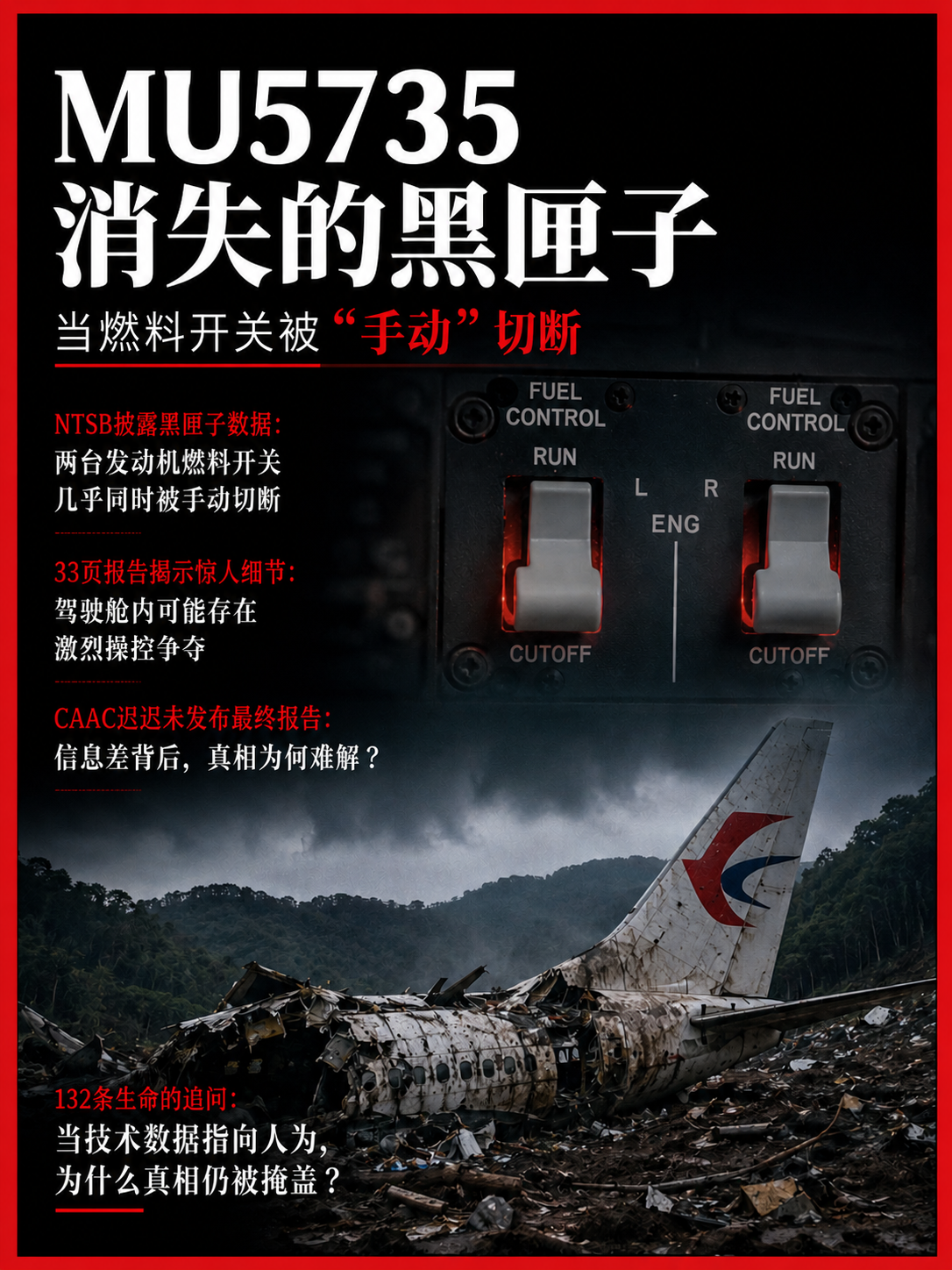
China Eastern MU5735 Crash: NTSB FOIA Black Box Data Raises New Questions About Fuel Switch Records
Meta Description: New NTSB FOIA-related black box data has renewed global attention on the China Eastern Airlines MU5735 crash. Reported flight data involving Boeing 737-800 engine fuel cutoff switch records raises serious questions about aviation safety, cockpit operations, and the delayed final CAAC investigation report.
Original Source: Artto News Original Article
The China Eastern Airlines MU5735 crash remains one of the most closely watched aviation disasters in recent years. On March 21, 2022, China Eastern Airlines Flight MU5735, a Boeing 737-800, crashed in Wuzhou, Guangxi, China. All 132 people on board were killed.
More than four years after the tragedy, the final cause of the MU5735 air disaster has still not been officially released. Now, newly discussed NTSB FOIA black box data has brought fresh international attention to the crash investigation, especially because of reported flight data involving the aircraft’s engine fuel control switches.
According to reports based on materials connected to the U.S. National Transportation Safety Board and the Freedom of Information Act, the flight data recorder allegedly showed that both engine fuel switches were moved to the CUTOFF position before the aircraft crashed.
If confirmed by the final official investigation, this data could become one of the most important pieces of evidence in understanding what happened during the final moments of China Eastern Flight MU5735.
What Happened to China Eastern Airlines Flight MU5735?
China Eastern Airlines Flight MU5735 was operating a domestic passenger flight when it suddenly entered a steep descent and crashed in southern China. The aircraft involved was a Boeing 737-800, one of the world’s most widely used narrow-body passenger jets.
The crash shocked the global aviation industry because of the aircraft’s sudden loss of altitude and the lack of an immediate official explanation. Since then, the MU5735 investigation has remained a major topic in discussions about aviation safety, black box analysis, pilot behavior, air crash investigations, and China aviation transparency.
NTSB FOIA Black Box Data: Why Is It Important?
The newly discussed information reportedly comes from materials linked to the NTSB and the Freedom of Information Act, commonly known as FOIA. These materials have attracted attention because they may include technical details from the aircraft’s black boxes, including the flight data recorder and cockpit-related data.
The NTSB was involved because the aircraft was a Boeing 737-800, manufactured in the United States. In major international air crashes involving U.S.-built aircraft, American aviation safety authorities may provide technical assistance to the official investigation led by the country where the accident occurred.
However, it is important to note that NTSB FOIA material is not the same as a final accident investigation report. It may provide technical data, but the official conclusion must still come from the responsible investigating authority. In this case, the final report from the Civil Aviation Administration of China, or CAAC, has not yet been released.
Reported Fuel Switch Data Becomes a Key Focus
The most discussed detail in the MU5735 black box data is the reported movement of both engine fuel control switches to the CUTOFF position before impact.
On a Boeing 737-800, the engine fuel control switches are not designed to be casually moved by accident. Operating them normally requires a deliberate physical action. This is why aviation analysts and observers have focused heavily on the reported fuel switch data.
If both fuel switches were indeed moved to CUTOFF before the crash, it could raise major questions about cockpit operations, human factors, pilot decision-making, aircraft systems, and flight safety protocols.
Still, without the final CAAC report, the fuel switch data should be treated as a serious investigative clue rather than a final conclusion. The complete crash analysis would need to consider flight recorder data, cockpit voice recordings, aircraft maintenance history, pilot background, weather conditions, air traffic control communications, and all other available evidence.
Why the MU5735 Final Investigation Report Matters
The delay in the final MU5735 crash report has become a major issue for aviation observers, victims’ families, journalists, and international safety experts.
A final air crash investigation report is important because it does more than explain what happened. It can also identify safety risks, recommend changes, improve airline procedures, strengthen pilot monitoring systems, and help prevent future accidents.
For the MU5735 crash, the final report could have major implications for several areas of global aviation safety:
- Boeing 737-800 flight safety
- Black box data transparency
- International air crash investigation cooperation
- Pilot mental health screening
- Cockpit security and monitoring
- Engine fuel cutoff switch procedures
- CAAC accident investigation transparency
- China Eastern Airlines safety management
Mechanical Failure or Human Factor?
Earlier official updates indicated that no obvious aircraft malfunction, severe weather condition, or air traffic control issue had been publicly confirmed. This is one reason why the reported NTSB FOIA fuel switch data has drawn so much attention.
In aviation investigations, the phrase human factor can cover many possibilities. It does not automatically mean intentional action. It may involve pilot decision-making, cockpit confusion, medical emergencies, crew coordination issues, procedural errors, mental health concerns, or other operational factors.
Because of this, any responsible analysis of MU5735 must avoid jumping to a final conclusion before the complete official report is released. The reported fuel cutoff switch data is important, but it must be interpreted within the full technical and investigative context.
Why MU5735 Still Matters to Global Aviation Safety
The MU5735 crash is not only a Chinese aviation tragedy. It is also a global aviation safety issue because it involves a widely used Boeing aircraft, international technical cooperation, black box data interpretation, and public trust in air crash investigations.
Major aviation disasters often lead to worldwide safety changes. If the final MU5735 report confirms new risks related to cockpit operations, fuel switch design, pilot monitoring, or airline safety procedures, the findings could influence aviation regulators, airlines, aircraft manufacturers, and safety organizations around the world.
1. Aviation Transparency
Public confidence in aviation safety depends on transparent and timely accident investigations. When final reports are delayed, speculation grows and trust declines.
2. Cockpit Safety and Pilot Monitoring
If human factors are confirmed, airlines and regulators may need to review how pilots are monitored, how mental health risks are assessed, and how cockpit safety procedures are designed.
3. Black Box Data Access
Flight data recorders and cockpit voice recorders are essential tools in modern air crash investigations. The MU5735 case highlights the importance of accurate data recovery, responsible disclosure, and international review.
4. International Accident Investigation Standards
Because modern aviation is global, major aircraft accidents often require cooperation between multiple countries. The MU5735 investigation shows why clear standards and transparent communication are critical.
Key Questions Still Unanswered
Despite the attention surrounding the NTSB FOIA-related data, many questions remain unanswered:
- When will the final CAAC report on MU5735 be released?
- Will the fuel switch data be officially confirmed?
- What did the cockpit voice recorder reveal?
- Was there any cockpit conflict, emergency, or abnormal crew behavior?
- Did the aircraft experience any system failure before the final descent?
- What safety recommendations will come from the investigation?
- How will China Eastern Airlines and aviation regulators respond?
These questions are central to understanding the MU5735 tragedy and preventing similar disasters in the future.
Conclusion: The Search for the Truth Behind MU5735 Continues
The China Eastern Airlines MU5735 crash remains an unresolved aviation tragedy. The reported NTSB FOIA black box data involving engine fuel switches has added a new layer of urgency to public discussion, but it has not replaced the need for a complete and official investigation report.
For the victims’ families, the aviation industry, and the global public, the most important issue is not speculation. It is transparency, evidence, and accountability.
Until the final CAAC report is released, the cause of MU5735 should not be treated as officially settled. But the reported flight data has made one thing clear: the world is still waiting for a full explanation of what happened in the final moments of China Eastern Flight MU5735.
SEO Keywords
China Eastern Airlines MU5735 crash, MU5735 crash investigation, China Eastern crash black box, NTSB FOIA MU5735, MU5735 black box data, Boeing 737-800 crash, China Eastern Airlines Flight MU5735, MU5735 fuel switch, engine fuel cutoff switch, CAAC final report, China aviation accident, Wuzhou plane crash, Guangxi plane crash, MU5735 final report, aviation safety investigation, flight data recorder, cockpit voice recorder, air crash investigation, China Eastern Boeing 737 crash, NTSB black box report, FOIA aviation safety, human factors aviation accident, pilot mental health aviation, Boeing 737-800 safety, aircraft fuel cutoff switch, China air disaster, global aviation safety, cockpit safety, aircraft accident transparency, aviation investigation report.
评论
发表评论